Serverless Security: Risks and Best Practices - Your Comprehensive Guide
Serverless computing is revolutionizing how applications are built and deployed. Its agility, scalability, and cost-effectiveness are undeniable. However, with this paradigm shift comes a new landscape of security challenges. Are you confident your serverless applications are secure? This post will explore the unique risks inherent in serverless architectures and provide actionable best practices to safeguard your functions and data.
Understanding the Serverless Security Landscape
Serverless, often synonymous with Functions as a Service (FaaS) like AWS Lambda, Azure Functions, and Google Cloud Functions, introduces specific security concerns distinct from traditional infrastructure. While the cloud provider handles underlying infrastructure security, you're responsible for the security of your application code, data, and configurations. Ignoring this responsibility can lead to severe vulnerabilities.
Unique Risks in Serverless Environments
Unlike traditional server-based systems, serverless applications have a few key characteristics that create new security challenges:
Increased Attack Surface: The highly distributed nature of serverless applications, with numerous small functions, expands the attack surface. Each function is a potential entry point for attackers.
Ephemeral Nature: Functions exist only for a short time during execution. This makes traditional security monitoring techniques, which rely on persistent agents, more challenging.
Shared Responsibility Model: It's crucial to understand the shared responsibility model with your cloud provider. They secure the infrastructure, but you secure your code and configurations. Misunderstanding this is a common source of vulnerabilities.
Complex Permissions Management: Defining and managing fine-grained permissions for each function is essential but can be complex. Overly permissive roles are a significant risk.
Dependency Vulnerabilities: Serverless functions often rely on third-party libraries and dependencies. These dependencies can contain known vulnerabilities that attackers can exploit.
Key Serverless Security Risks and How to Mitigate Them
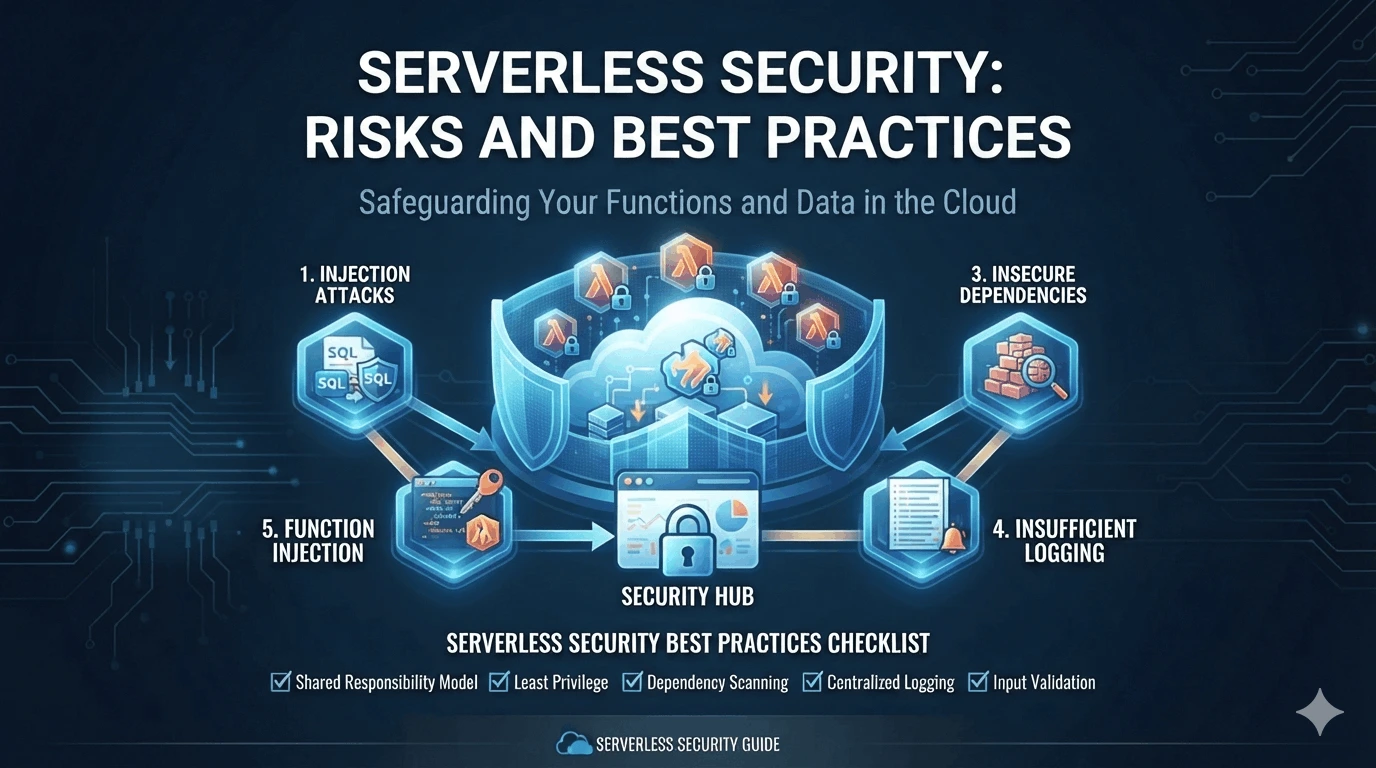
1. Injection Attacks (SQL Injection, Command Injection)
Risk: Injection attacks occur when untrusted data is incorporated into queries or commands without proper sanitization. This can allow attackers to execute arbitrary code or access sensitive data.
Mitigation:
Input Validation and Sanitization: Thoroughly validate and sanitize all user inputs before using them in queries or commands.
Prepared Statements/Parameterized Queries: Use prepared statements or parameterized queries to prevent SQL injection. These techniques separate the data from the query structure.
Principle of Least Privilege: Ensure your functions only have the minimum necessary permissions to perform their tasks. Avoid granting overly broad database access.
Example: Instead of directly embedding user input into a SQL query, use a parameterized query in your chosen language (e.g., Python with a database connector):
    # Insecure (Vulnerable to SQL injection)
    query = "SELECT * FROM users WHERE username = '" + user_input + "'"

    # Secure (Using parameterized query)
    cursor.execute("SELECT * FROM users WHERE username = %s", (user_input,))
2. Broken Authentication and Authorization
Risk: Weak or nonexistent authentication and authorization mechanisms can allow unauthorized access to your serverless functions and data.
Mitigation:
Strong Authentication: Implement robust authentication mechanisms, such as multi-factor authentication (MFA) and strong password policies.
Fine-Grained Authorization: Use IAM roles and policies to define granular permissions for each function. Only grant the permissions necessary for the function to perform its intended purpose.
Regularly Review Permissions: Periodically review and update IAM roles and policies to ensure they remain appropriate and do not grant excessive privileges.
Use Cloud Provider's Identity and Access Management (IAM): Leverage the IAM features of your cloud provider (e.g., AWS IAM, Azure Active Directory) to manage access control effectively.
3. Insecure Function Dependencies
Risk: Serverless functions often rely on third-party libraries and dependencies, which can contain known vulnerabilities. Exploiting these vulnerabilities can compromise your function's security.
Mitigation:
Dependency Scanning: Use dependency scanning tools to identify and track vulnerabilities in your function's dependencies. Tools like Snyk, OWASP Dependency-Check, or the built-in security scanners offered by your CI/CD pipeline can automate this process.
Keep Dependencies Up-to-Date: Regularly update your function's dependencies to the latest versions to patch known vulnerabilities.
Use a Vulnerability Management System: Implement a vulnerability management system to track and prioritize vulnerabilities in your serverless applications.
Containerization (Optional): Consider containerizing your functions using Docker or other container technologies. This allows you to define a controlled environment with known and patched dependencies.
4. Insufficient Logging and Monitoring
Risk: Lack of adequate logging and monitoring makes it difficult to detect and respond to security incidents. The ephemeral nature of serverless functions exacerbates this issue.
Mitigation:
Centralized Logging: Implement centralized logging to collect logs from all your serverless functions in a single location.
Comprehensive Monitoring: Monitor your functions for suspicious activity, performance anomalies, and security events.
Alerting and Notifications: Set up alerts and notifications to be notified of security incidents in real-time.
Consider Security Information and Event Management (SIEM) Solutions: For larger deployments, consider integrating a SIEM solution to correlate security events from various sources and provide a comprehensive view of your security posture.
5. Serverless Function Injection
Risk: Similar to code injection vulnerabilities in traditional applications, serverless functions can be vulnerable to function injection. This occurs when an attacker can inject malicious code or commands into the function's execution environment.
Mitigation:
Input Validation and Sanitization: As with injection attacks, rigorously validate and sanitize all user inputs to prevent attackers from injecting malicious code.
Secure Coding Practices: Follow secure coding practices to avoid vulnerabilities that could be exploited for function injection.
Principle of Least Privilege: Grant your functions only the minimum necessary permissions to prevent attackers from escalating their privileges.
Serverless Security Best Practices: A Checklist
Here's a quick checklist of serverless security best practices to get you started:
Understand the Shared Responsibility Model
Implement Strong Authentication and Authorization
Enforce Least Privilege Principle
Use Dependency Scanning Tools
Keep Dependencies Up-to-Date
Implement Centralized Logging and Monitoring
Validate and Sanitize All Inputs
Use Prepared Statements/Parameterized Queries
Regularly Review and Update Security Configurations
Automate Security Testing and Vulnerability Management
Conclusion
Securing serverless applications requires a different mindset and skillset compared to traditional infrastructure. By understanding the unique risks and implementing the best practices outlined in this guide, you can significantly enhance the security of your serverless deployments. Remember that security is an ongoing process, and continuous monitoring, assessment, and adaptation are crucial to stay ahead of emerging threats. Embrace these practices to unlock the full potential of serverless computing while mitigating the associated risks.