Architecting Agent Memory: Principles, Patterns, and Best Practices
In the rapidly evolving landscape of Large Language Models (LLMs), the transition from simple prompt-response interactions to autonomous, long-lived AI agents is the defining shift of the decade. However, an agent is only as capable as its ability to retain, organize, and retrieve information. Without a robust memory architecture, an agent is perpetually "amnesiac," forced to reinvent its strategy with every new interaction.
Architecting effective agent memory is the cornerstone of building sophisticated AI systems that can operate across multiple sessions, maintain complex state, and personalize experiences. In this post, we explore the fundamental principles, architectural patterns, and industry best practices for building scalable memory systems for AI agents.
The Taxonomy of Agent Memory
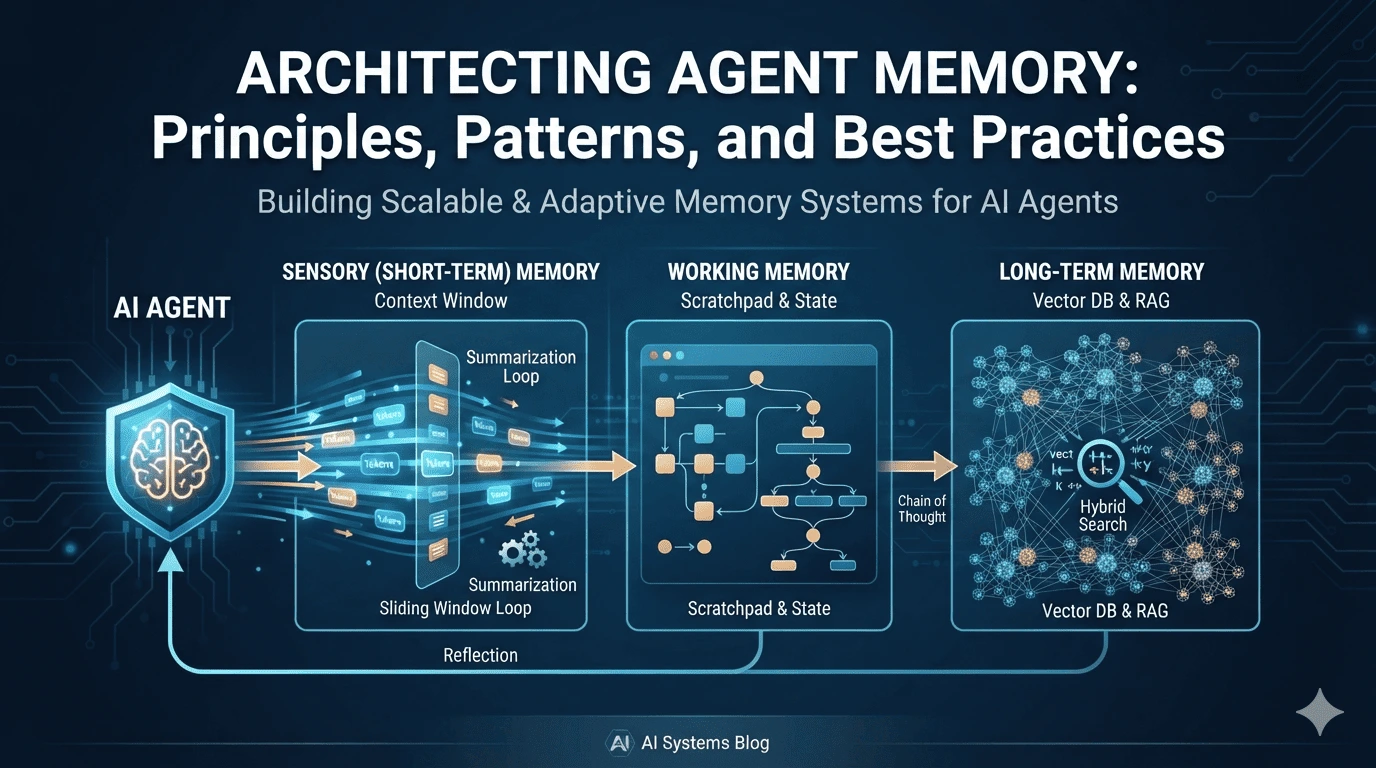
To architect a system, we must first categorize the types of memory. Drawing parallels from human cognitive science, AI memory is generally categorized into three distinct layers:
1. Sensory (Short-term) Memory
This is the context window. It encompasses the immediate data present during an active turn or conversation. It is high-bandwidth, volatile, and essential for maintaining coherence in the current task. Managing this requires strict token budget optimization.
2. Working Memory
Working memory acts as the agent's "scratchpad." It holds the current task state, temporary variables, and intermediate reasoning steps (often referred to as Chain of Thought). It allows the agent to hold multiple threads of logic simultaneously without losing the plot.
3. Long-term (Episodic and Semantic) Memory
This is the repository of facts, past experiences, and learned preferences. It is generally implemented via Vector Databases (like Pinecone, Milvus, or Weaviate) and allows the agent to perform Retrieval-Augmented Generation (RAG) to pull in historical context as needed.
Core Architectural Patterns
How do you glue these layers together? Effective memory management relies on three primary architectural patterns:
The Sliding Window Pattern
This is the most common approach for short-term memory. As new information enters the context, the oldest information is truncated. To avoid losing critical data, sophisticated implementations use summarization loops, where the system periodically collapses old conversation turns into a dense summary, preserving the "essence" of the history while freeing up tokens.
The Retrieval-Augmented Pattern
For long-term memory, retrieval is key. Instead of loading everything into the context window (which is costly and inefficient), the agent queries a database. Semantic search allows the agent to find relevant information based on the user's intent rather than just keyword matches. A best practice here is to use a Hybrid Search approach, combining vector similarity with traditional BM25/keyword search for precision.
The Reflection and Synthesis Pattern
Advanced agents are now being designed to "sleep" and process data. During these idle cycles, the agent reviews its recent logs, extracts key learnings, and updates its profile of the user. By synthesizing these experiences, the agent evolves its behavior over time, effectively "learning" from previous interactions.
Best Practices for Robust Memory Systems
Architecting for memory is not just about storage; it is about performance and relevance. Follow these best practices to ensure your agent remains sharp and responsive:
Implement Data Decay (Forgetting): Not all information is worth keeping. Implement a "decay" factor for memories that haven't been accessed in a long time. This prevents your knowledge base from becoming cluttered with irrelevant noise.
Metadata-Driven Filtering: When querying long-term memory, don't just rely on similarity scores. Use metadata (timestamps, category tags, session IDs) to filter search results. This ensures the agent isn't retrieving context from a project that concluded six months ago.
Memory Tiering: Architect your system to treat recent, high-priority information (like a user's current goal) differently than deep-archive logs. Keeping high-priority context in a Redis cache for lightning-fast retrieval while offloading long-term logs to a vector DB is a standard enterprise-grade approach.
Security and Privacy-by-Design: Remember that memory stores sensitive data. Implement Role-Based Access Control (RBAC) at the database level and consider PII (Personally Identifiable Information) masking before storing logs in long-term memory.
The Future: Toward Adaptive Architectures
The next frontier in agent memory is dynamic retrieval—the ability of an agent to decide when it needs to look at its memory. Currently, most systems blindly query the database on every turn. An "agentic" memory system should perform a routing task: "Do I have enough information to answer this, or should I query my long-term storage?"
By moving from static retrieval to agent-driven memory access, we reduce latency, lower costs, and significantly improve the reasoning quality of our AI systems.
Conclusion
Architecting agent memory is the difference between a chatbot that repeats itself and an agent that builds a meaningful, long-term partnership with its user. By treating memory as a multi-layered infrastructure—combining efficient short-term management with intelligent long-term retrieval—developers can create systems that feel truly autonomous.
Start small: implement a robust sliding window, establish a structured RAG pipeline for long-term storage, and always prioritize the relevance of the retrieved data. As you refine your architecture, you will find that the agents you build don't just process information—they develop experience.