Building Event-Driven Microservices on AWS: Integrating EventBridge with ECS Fargate
Modern cloud architectures demand loose coupling, high availability, and seamless scalability. When designing microservice ecosystems on AWS, point-to-point HTTP requests between containerized services often create tight dependencies, latency bottlenecks, and cascading failures.
By placing Amazon EventBridge at the center of your Amazon ECS Fargate microservices, you transform your application into a fully event-driven, resilient system.
Why Event-Driven with EventBridge?
Traditional synchronous communication requires services to know where their targets live and depend on immediate responses. An event-driven architecture with EventBridge flips this model:
Loose Coupling: Services publish events to a central bus without knowing who consumes them.
Asynchronous Execution: Non-blocking workloads improve user-facing API response times.
Extensibility: Adding a new consumer (e.g., analytics, notifications) requires zero code changes to the producer.
Architecture Overview
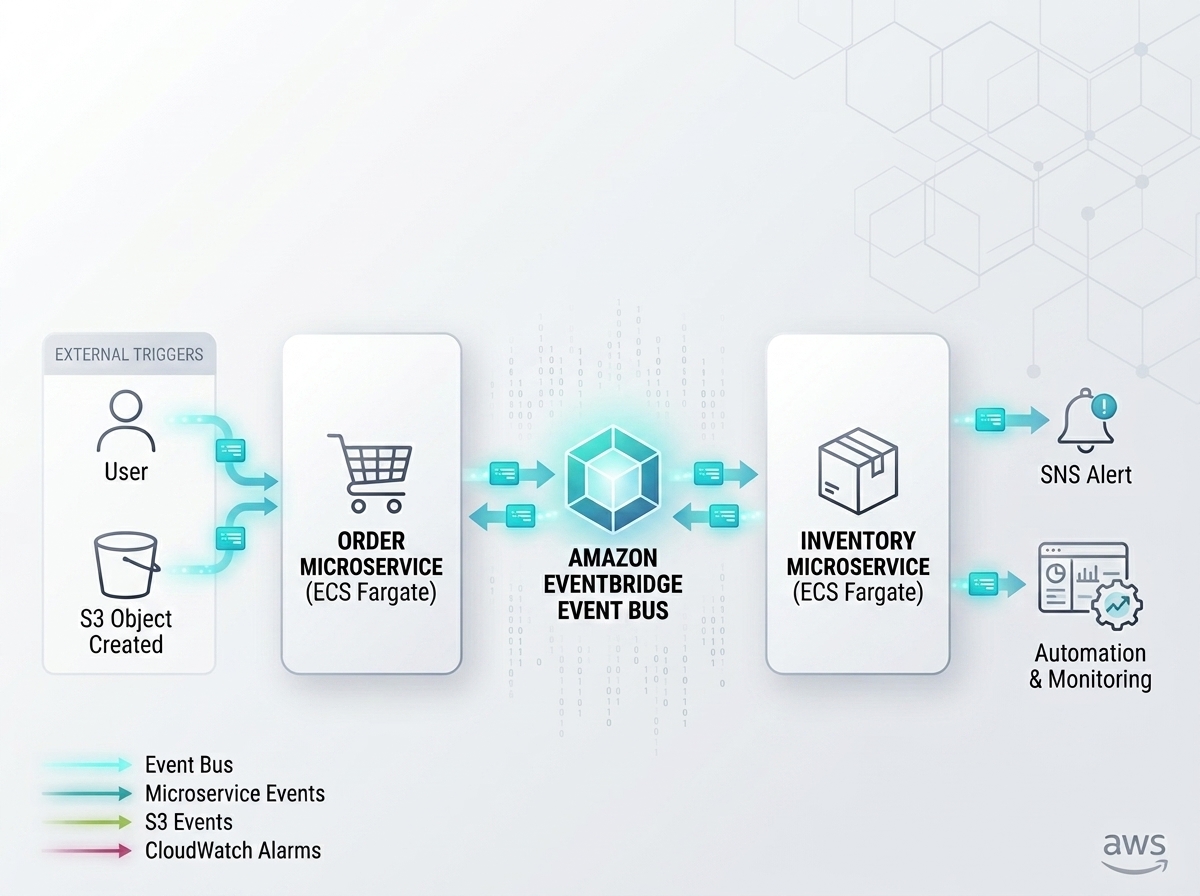
The diagram above illustrates a multi-region, resilient AWS footprint leveraging EventBridge as the central event router across containerized microservices and auxiliary services.
Architecture Components
Component Role in Architecture Amazon EventBridge Central event bus acting as the core router for all application and system events ECS Fargate Containers Serverless containers hosting decoupled microservices (e.g., Order Service, Inventory Service)Amazon S3Storage layer generating object-creation events to trigger downstream background tasks Amazon SNS & CloudWatch Monitoring, logging, and real-time alert dispatching for operational health
How the Event Flow Works
Event Ingestion: External user requests arrive via the Application Load Balancer into the Order Microservice, while direct file uploads generate object events in Amazon S3.
Publishing to EventBridge: Instead of calling the Inventory Microservice directly via REST, the Order Microservice emits a structured JSON event (e.g., OrderCreated) to the Amazon EventBridge Event Bus.
Filtering & Routing: EventBridge evaluates rules against the incoming event payload and routes it concurrently to target subscribers—such as pushing to the Inventory Microservice for stock deduction and triggering an Amazon SNS notification.
Observability & Health: System status and application logs route directly through CloudWatch, ensuring any failures automatically trigger alerts or fallback workflows.
Key Benefits
No Server Management: Fargate manages the container infrastructure while EventBridge handles serverless event routing.
Built-in Error Handling: EventBridge includes dead-letter queues (DLQs) and configurable retry policies for failed deliveries.
Production-Ready Security: Network isolation via Private Subnets, encrypted state via AWS KMS, and granular role management with IAM Identity Center keep your event pipeline secure.
Integrating Amazon EventBridge with ECS Fargate gives your microservices the freedom to scale independently, evolve gracefully, and maintain bulletproof operational reliability.