The Rise of AI Agents: How Smart Businesses Are Working Faster, Smarter, and Better
Artificial Intelligence is no longer just a futuristic concept. It has become a practical business tool that helps companies improve productivity, reduce manual work, and make better decisions. One of the biggest developments in this space is the rise of AI agents.
AI agents are changing the way businesses operate. They can handle tasks, analyze information, respond to customers, support teams, and help companies work more efficiently. For modern businesses, AI agents are becoming more than just technology. They are becoming digital teammates.
What Are AI Agents?
AI agents are intelligent software systems that can perform tasks with a certain level of independence. Unlike basic automation tools that follow fixed rules, AI agents can understand instructions, process information, make decisions, and take action based on goals.
For example, an AI agent can help schedule meetings, answer customer questions, generate reports, analyze data, manage workflows, or support sales and marketing teams. Instead of waiting for step-by-step commands, AI agents can work toward a result.
This makes them powerful tools for businesses that want to save time, reduce repetitive work, and improve overall performance.
Why Businesses Are Adopting AI Agents
Businesses today move fast. Teams are expected to handle more work, respond quickly to customers, and make decisions based on real-time information. Traditional tools are often not enough to keep up with this speed.
AI agents help solve this problem by taking care of time-consuming tasks and supporting employees in their daily work. They allow teams to focus on strategy, creativity, customer relationships, and business growth.
Companies are adopting AI agents because they help with:
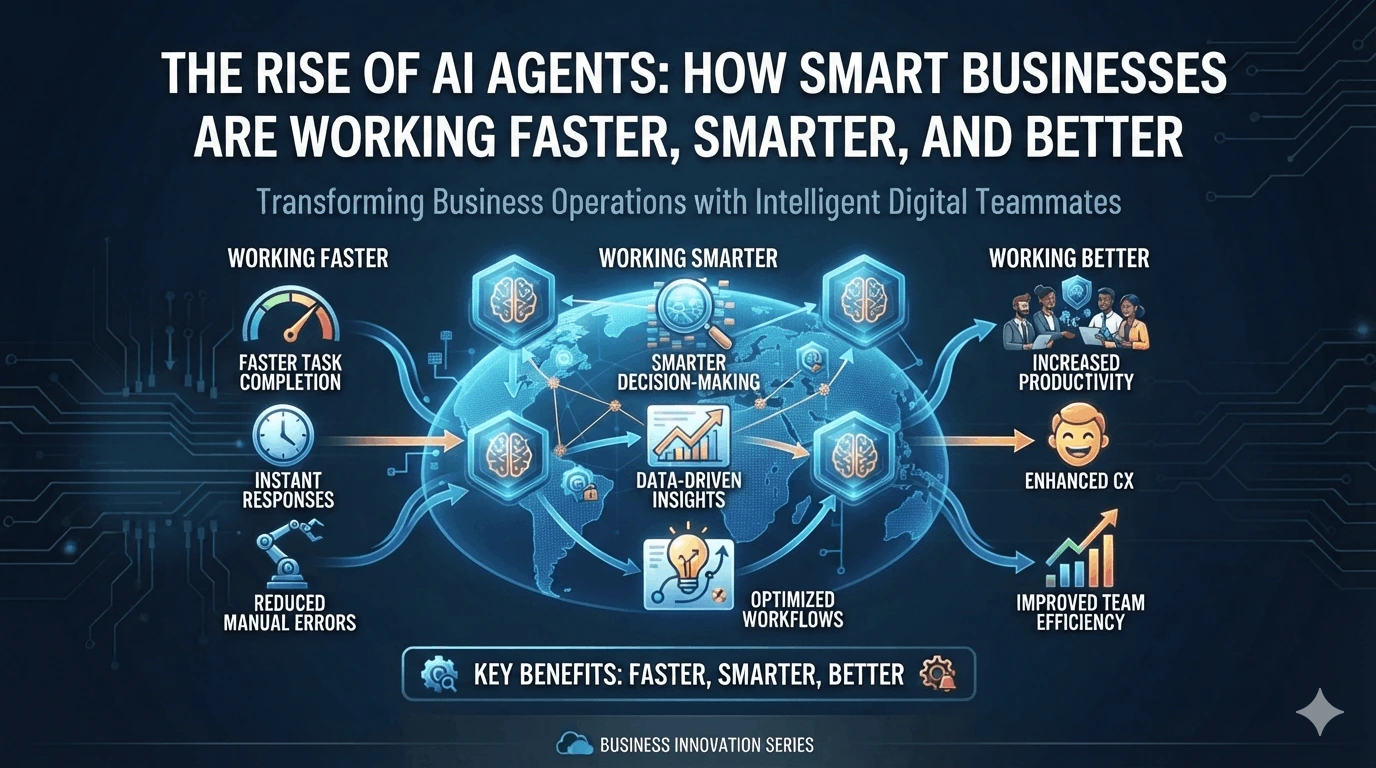
Faster task completion
Better customer support
Improved team productivity
Reduced manual errors
Smarter decision-making
Lower operational workload
Better use of company data
In simple terms, AI agents help businesses do more with less effort.
How AI Agents Help Businesses Work Faster
Speed is one of the biggest advantages of AI agents. Many business tasks that once took hours can now be completed in minutes.
An AI agent can quickly review documents, summarize long reports, respond to common customer questions, create content drafts, organize information, or generate insights from data. This saves valuable time for employees and helps businesses respond faster to opportunities.
For example, a customer support team can use AI agents to answer frequently asked questions instantly. A sales team can use AI agents to qualify leads and prepare follow-up messages. A marketing team can use AI agents to research topics, draft campaigns, and analyze performance.
By reducing delays and manual effort, AI agents help businesses move at a much faster pace.
How AI Agents Help Businesses Work Smarter
Working faster is important, but working smarter is even more valuable. AI agents help businesses make better decisions by turning data into useful insights.
Many companies collect large amounts of information from customers, sales, websites, campaigns, and internal operations. However, this data is often difficult to manage and understand. AI agents can analyze this information and identify patterns, trends, and opportunities.
This helps businesses understand what customers want, which strategies are working, and where improvements are needed.
For example, an AI agent can analyze customer feedback and highlight common complaints. It can review sales data and show which products are performing best. It can study marketing results and suggest which campaigns need improvement.
With AI agents, businesses can make decisions based on information instead of guesswork.
How AI Agents Improve Customer Experience
Customer expectations are higher than ever. People want quick replies, personalized service, and smooth experiences. AI agents can help businesses meet these expectations.
AI-powered agents can answer customer questions instantly, guide users through processes, recommend products or services, and provide support at any time of day. This improves response time and creates a better customer experience.
They can also help human support teams by handling simple requests, so employees can focus on complex customer needs. This creates a balance between automation and human service.
When used correctly, AI agents do not replace human connection. They support it by making service faster, more consistent, and more helpful.
AI Agents and Employee Productivity
AI agents are not just useful for customers. They are also valuable for internal teams.
Employees often spend a large part of their day on repetitive tasks such as writing emails, updating records, searching for information, preparing reports, and managing schedules. AI agents can reduce this workload and help employees focus on higher-value work.
This leads to better productivity and job satisfaction. When employees are free from repetitive tasks, they can spend more time solving problems, building relationships, improving services, and creating new ideas.
In this way, AI agents help teams become more efficient and more creative.
Common Business Use Cases for AI Agents
AI agents can be used across many departments and industries. Some common use cases include:
Customer Support: Answering common questions, managing tickets, and helping customers find solutions.
Sales: Qualifying leads, preparing follow-up emails, updating CRM systems, and identifying sales opportunities.
Marketing: Creating content ideas, drafting campaigns, analyzing audience behavior, and tracking performance.
Human Resources: Screening resumes, answering employee questions, scheduling interviews, and supporting onboarding.
Operations: Managing workflows, generating reports, tracking tasks, and improving internal processes.
Finance: Organizing invoices, detecting unusual patterns, preparing summaries, and supporting financial analysis.
These examples show how flexible AI agents can be. They can support almost every part of a business.
The Difference Between AI Agents and Traditional Automation
Traditional automation is useful, but it usually follows fixed instructions. It works well for simple and repetitive tasks. However, it may struggle when situations change or when tasks require understanding and decision-making.
AI agents are more advanced. They can understand context, adapt to different situations, and complete more complex tasks. Instead of only following rules, they can work toward goals.
For example, traditional automation might send a standard email after a customer fills out a form. An AI agent can review the customer’s message, understand their interest, personalize the response, and suggest the next best action.
This is why AI agents are becoming a major step forward in business technology.
Challenges Businesses Should Consider
While AI agents offer many benefits, businesses should use them carefully. Successful AI adoption requires planning, clear goals, and proper monitoring.
Companies should consider data privacy, accuracy, security, and ethical use. AI agents should be tested before being used in important workflows. Human review is also important, especially for tasks involving customers, finance, legal matters, or sensitive information.
AI agents work best when they support people, not when they are used without control. A smart business uses AI responsibly and makes sure the technology aligns with company values and customer trust.
The Future of AI Agents in Business
The future of business will be shaped by intelligent tools that help people work better. AI agents are becoming a key part of this transformation.
As the technology improves, AI agents will become more capable, more personalized, and more connected with business systems. They will help companies manage complex workflows, deliver better customer experiences, and make faster decisions.
Businesses that adopt AI agents early will have an advantage. They will be able to operate more efficiently, serve customers better, and adapt quickly to change.
Final Thoughts
AI agents are not just another trend. They represent a new way of working.
They help businesses work faster by reducing manual tasks. They help businesses work smarter by turning information into insight. They help businesses work better by improving customer experience, team productivity, and decision-making.
For companies that want to grow in a competitive market, AI agents offer a powerful opportunity. The businesses that understand and use this technology wisely will be better prepared for the future.
The rise of AI agents has already begun. Now is the time for smart businesses to explore how they can use them to move faster, work smarter, and achieve better results.